Showing posts with label social media. Show all posts

Wednesday, August 3, 2016

Avoid Trouble: How to Create a Social Media Policy For Any Business

Find out what's at stake for your business and how to create a policy in easy steps in this new book.

Order your copy of Social Media Media Ethics Made Easy at  Business Expert Press


Available at Amazon: http://amzn.to/2t2wFrQ


Print Price: $34.95
E-book Price: $19.95
Number of Pages:  120
Print ISBN:  9781606498521
E-book ISBN:  9781606498538

Social Media Ethics Made Easy takes an in-depth look at the risks of social, digital and mobile media marketing without structured policies. Readers will learn what is at stake from the law to their reputation, and what happens if businesses and/or individuals do not disclose relationships or comply with (FTC) Federal Trade Commission regulations. Readers will come to understand what they should do, why, and how they should do it.

The issues in this book affect every single business from for-profits, to nonprofits, to government and educational institutions. It also addresses the impact on every single social/digital media participant and why they must learn about these guidelines so they can protect their own personal brand. This book is intended for a broad audience including students and professors in both undergrad and graduate schools, and practicing business executives. The goal is to inform management practice and help current and future business leaders navigate through the ethical laws and compliance issues affecting social, digital and mobile media.

Joe Barnes is a highly sought-after digital media marketing strategist, conference speaker and trainer. He consults on major media, social/digital media, strategic communications, public relations, and marketing initiatives. His clients have ranged from small businesses to Fortune 500 companies, nonprofits and leading government agencies. Joe understands and leverages consumer insights to provide solutions and ideas that bridge TV, web, mobile, social media, email, search, advertising, etc., and maximize consumer engagement. He answers key questions such as how brands are communicated and experienced through digital interactions, and how digital interactions fit into broader customer experiences. Joe is known for his passion for innovation and the customer experience, combined with a sound understanding of consumers, social networks, and brands. As a journalist/storyteller he has led teams that have won countless Emmy® Awards and the prestigious Edward R. Murrow Award for Outstanding Journalism. He’s an educator at Seattle University; has an MA Degree; is quoted in two books; is on several boards; and is a certified Leadership Trainer.
Contact Joe Barnes about speaking to your group: joe@digital3000.net

Wednesday, June 22, 2016

How People Use Social Media at Work!


PEW is out with a new study giving us some great insights into how people are using social media at work.

"The new Pew Research Center survey finds that social media plays some role in the lives of many American workers – but that role is not always clear-cut or entirely positive."

Quoting from the report:

Workers turn to social media for a range of reasons while at work, with taking a mental break being among the most common.

34% use social media while at work to take a mental break from their job
27% to connect with friends and family while at work
24% to make or support professional connections
20% to get information that helps them solve problems at work
17% to build or strengthen personal relationships with coworkers
17% to learn about someone they work with
12% to ask work-related questions of people outside their organization
12% to ask such questions of people inside their organization


Some 14% of workers have found information on social media that has improved their professional opinion of a colleague; at the same time, a similar share (16%) have found information on social media that has lowered their professional opinion of a colleague.

Many employers now have rules for how employees use social media at work.

Policies that regulate how employers present themselves online outside of work may be expected to influence whether these workers use social media at all. However, this does not seem to be the case: Fully 77% of workers report using social media regardless of whether their employer has such a policy in place.

Wednesday, August 19, 2015

New Stats: Mobile Messaging and Social Media


In today’s world, people — particularly young people — are continually finding and adapting new ways of communicating electronically to fit their needs. Case in point: 2015 marks the first time Pew Research Center has asked specifically about mobile messaging apps as a separate kind of mobile activity apart from cell phone texting. And already, according to a new survey, 36% of smartphone owners report using messaging apps such as WhatsApp, Kik or iMessage, and 17% use apps that automatically delete sent messages such as Snapchat or Wickr.
Both of these kinds of apps are particularly popular among young adults. Half (49%) of smartphone owners ages 18 to 29 use messaging apps, while 41% use apps that automatically delete sent messages. These apps are free, and when connected to Wi-Fi, they do not use up SMS (Short Messaging Service) or other data. Furthermore, they offer a more private kind of social interaction than traditional social media platforms such as Facebook or Twitter.
The results in this report reflect the noteworthy and rapid emergence of different kinds of communications tools serving different social needs. These new tools add to an already complex and varied terrain of online and mobile interaction.
Overall, this survey found that 85% of adults are internet users and 67% are smartphone users. Throughout this report, analysis is largely based on these groups.
Along with asking about usage of mobile messaging apps, the survey also tracked usage of a variety of social media platforms and online forums. Among the key findings:
Pinterest and Instagram Usage Doubles Since 2012, Growth on Other Platforms is Slower
The analysis in this report is based on telephone interviews conducted March 17, 2015 through April 12, 2015 among a national sample of 1,907 adults, 18 years of age or older, living in all 50 U.S. states and the District of Columbia. 672 respondents were interviewed on a landline telephone, and 1,235 were interviewed on a cell phone, including 730 who had no landline telephone. Of the full sample, 1,612 are internet users. The margin of sampling error for results based on the full sample is plus or minus 2.6 percentage points. Because many items were based on half samples, results based on internet users in this report have a margin of sampling error of either plus or minus 3.9 percentage points or plus or minus 4.0 percentage points. Results based on smartphone owners have a margin of error of plus or minus 4.6 percentage points. See the Methods section at the end of this report for more details.

Tuesday, August 11, 2015

7 Steps to Successful Social Media Marketing


Many clients have asked me the "secret" to social media marketing success. I always tell them, there is no secret, but you need a strategic plan. 


My advice, use my 7 Steps to Successful Social Media Marketing. 

1. Every business is now in the publishing business. 

You must create and share interesting and relevant content with words, pictures, and video. People are looking for solutions, for help, for opportunities to learn, and to share. Create authentic and meaningful relationships through relevant content that helps their life.

2. Social media is about creating strategic conversations that lead to meaningful connections. 

The goal is to create community. We can only talk in person to a limited number of people, however, social media allows us to listen to hundreds, and sometimes, thousands more, respond, and demonstrate who we really are and what we stand for.

3. Whenever we post we must ask ourselves some tough reminder questions:
a) Why would anyone follow us on (Facebook, Twitter, Instagram, Pinterest, LinkedIn, YouTube, etc)?
b) Why does anyone care about this content?
c) Why are we posting this content? What is the action/outcome we want?

4. How can we engage our followers?
a) By posting relevant and interesting content that is meaningful to them 80% of the time. (Do self promotion only 20% of the time)
b) After posts ask questions that prompt engagement. (Have you tried this technique? Let us know how it has worked for you? I suggest a list of about 25 stock questions ready to be asked).
c) Offer incentives for participation. Before TurboTax was well known, the brand ran a contest on YouTube for the best rap (yes I said rap) music video about the product and gave a cash award. The brand had hundreds of entries and thousands of views.

5) Respond to posts quickly. We wouldn't leave a potential or current customer waiting at our business or on the phone for several hours or days, so why do we do that on social media? How and when we respond is seen by current and potential customers.

6) Find out your Prime Time: As you post you will begin to see when prime time is for your followers on a specific platform. In some cases it may be weekday mornings, in other cases it may be 3pm-9pm. Look for reach, shares, and comments, as these will give you clues to your prime time.

7) Be repeatable, relevant, and inspiring.


Wednesday, July 22, 2015

Power of Storytelling and Social Media


Talk About Powerful Stories? This one is powerful and demonstrates the dark side of social media. 


Source: https://www.youtube.com/watch?v=OVnRcIXEqaU

Friday, May 8, 2015

Are Social Media Fads Fueling Risky Behavior?


There's an interesting story reported by CBC news today showing how social media may be fueling risky behavior, from the cinnamon challenge to car surfing.    

  
Some of these challenges are downright stupid and dangerous.

The latest, Game of 72, challenges teens to find ways to disappear for three days. In the cinnamon challenge shown on YouTube, participants swallow a spoonful of ground cinnamon in 60 seconds without water. Then there is the salt and ice challenge. A Pittsburgh boy "burned" a cross into his back in 2012 by holding ice to a layer of salt on top of his skin. Last October, the U.S. Forest Service issued a plea to tourists to leave the bears alone. Wildlife officials singled out visitors to South Lake Tahoe in California after snapshots of young people posing with grizzly bears in the background surfaced on Instagram and Twitter (See picture).


Wednesday, April 29, 2015

Social media is the fastest growing source of e-commerce traffic

Social media is the fastest growing source of e-commerce traffic 
Cooper Smith | April 29, 2015
(c) BuisnessInsider.com
bii social ecommerce referral traffic3 1

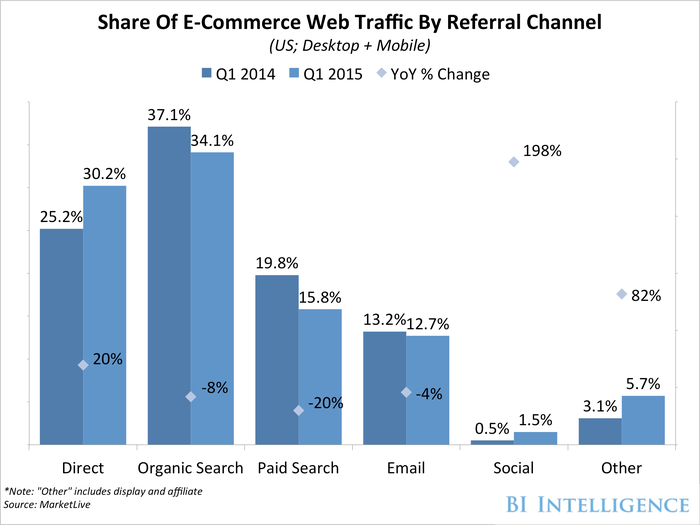
In absolute terms, social media isn't a huge driver of e-commerce traffic, but that's quickly changing. In fact, social media is the fastest growing source of traffic for online shopping sites (mobile and desktop) at a time when search's share of total referrals is shrinking, according to data sent to us by MarketLive.  

  • Social traffic to e-commerce sites is growing far faster than other referral channels. Social media increased its share of e-commerce referrals nearly 200% between the first quarters of 2014 and 2015. Roughly 2% of all e-commerce traffic in the US now stems from social networks such as Facebook, Pinterest, and Twitter.  

  • Search — particularly paid search — is seeing its share of referrals shrink. Paid search's share of online shopping traffic declined 20% year-over-year (YoY) and now accounts for just 16% of total e-commerce traffic. Meanwhile,organic search's share of traffic declined 8% YoY and now accounts for 34% of total e-commerce traffic. 

  • Referral traffic from email remains fairly consistent. Email's share of online shopping traffic declined slightly YoY, and still accounts for roughly 13% of all e-commerce traffic on desktop and mobile in the US. 

The data suggests that consumers are increasingly exhibiting shopping behavior on social networks. As a result, brands and retailers should be allocating a larger share of their marketing resources to social platforms like Facebook. 


It's also important to note that a greater and increasing share of e-commerce traffic is coming from direct site visits. This suggests that shoppers are becoming increasingly loyal to particular e-commerce sites. So consumers are relying less on search and more on their past experiences to decide which shopping sites they visit. 

Wednesday, April 22, 2015

Are Your Posts As Relevant and Interesting as They Could Be? Should Be?


Relevant? Interesting?


Everyday people ask me what they should post. I always give them the same answer: News that is relevant and interesting to your followers. The rule is that 80% of your posts should be relevant and interesting to your followers, and only 20% self-promotion. Why? Who wants to follow a business that only promotes itself (unless you are giving out 50% off coupons). 


In business, as in life, to get sales, you need to help your clients and customers be more successful. To do that effectively you need to know them well, know their wants and needs, and give them information and news that will help them.


If you are a medical facility, what are the health stories that will be of interest to your patients? High tech? What are the industry stories your clients want to know? 


It's all about being known as a "thought leader," creating and having the conversations that are relevant to your clients, and giving them information that will help them succeed. That is what builds bonds and relationships. That is what builds meaningful sales leads.


Tuesday, April 14, 2015

Study: Half of Kids Admit to Hurtful Social Networking


One-half of middle- and high school students in a recent study admit to social media abuse — from bullying schoolmates to spreading rumors to pressuring others to send sexual texts or pictures. They also admitted to stalking their partners.
"It begins with the constant texting or the stalking on Facebook. 'Where are you?' and 'Who are you with?' " said researcher Poco Kernsmith, an associate professor of social work at Wayne State University.
What may seem like harmless teen jealousy can spiral into a dangerous relationship if left unchecked, said Kernsmith, whose research has centered on violence in relationships.
"It becomes 'I don't want you to hang out with your friends,' and 'I don't like the way you dress.' It becomes controlling and isolating."
Just 37% of the students said their parents monitored their online behavior. It's a disconnect that — maybe not surprising 
Additionally, social media misuse was higher in wealthier districts — very likely the result of more kids owning cell phones and other technology. About 54% of youth in low-risk schools — relatively wealthier schools in low-crime areas — had perpetrated electronic abuse, while 46% of youth in high-risk schools had done so.
One student interviewed for the study described how her behavior would change if her mother might check her social networking: "I have a filthy mouth, and I write filthy things, so I would just monitor my mouth more, 'cause I know my mom would be all over me like hotcakes."
5 reminders for your kids
If you're opening that conversation with kids — or even offering reminders from earlier talks — about what's appropriate online and what's not, Wayne State University researcher Poco Kernsmith suggests these five points.
Remember: Nothing is private online.
Remember: Nothing online can be taken back.
Be aware of pressure and coercion.
Consider the reaction and feelings of others.
Remember: Nothing is anonymous.

Monday, November 10, 2014

Why Relevance Is So Important!


The following is from eMarketer an demonstrates a key point we make frequently which is that marketing must be relevant to the lives of your customers. Their *S meter is strong and unless you are offering relevant and interesting content to their lives, your marketing messages are just "noise."
According to a story in eMarketer, "Some 6 in 10 respondents to a Hipcricket survey say they engage with up to 10 brands a month via their mobile devices, with many having received a text message or mobile alert from a brand during the past 6 months. However, only 45% found the message or alert to be useful, per the study, with the primary complaints being that the messages feel “intrusive or spammy” (52%), that they’re not relevant to their interests (46%) and that they don’t offer any value (33%). These appear to be common complaints not confined to mobile marketing.
Early this year, a study from Janrain and Blue Research found that almost all respondents claimed to have received information or promotions not relevant to them, including offers that: show the company doesn’t know who they are (71%); contain mixed information across different methods of communication (51%); or include basic errors about the consumers’ identities (41%).
Relevance is the key, anything less is just noise.

Wednesday, July 9, 2014

Are you a "mesher" or a "stacker?"


Are you a "mesher" or a "stacker?"

Forget "selfies." The new words being used are "meshers" and "stackers." These come to us from an excellent Ad Reaction survey by Millward Brown "Marketing in a Multi-Screen World."
How are they defined and how are they different?
Meshers are people who use simultaneously use the Internet to interact with the TV show they are watching -- 24% of us are Meshers.
Stackers are people who are watching TV and simultaneously using the Internet to check Facebook, Twitter, Google, etc.  -- 76% are Stackers.
What does this research tell us? "The biggest multiscreen marketing opportunity is shifting (65% of screen time). Brands can take advantage of shifting by using synergistic multiscreen campaigns."

Friday, May 16, 2014

The 5 Lessons Marketing Students Need to Learn Now to Succeed!


Learn The Lessons You Will Need to Be Successful!


I was asked today what college/university students should be studying to be successful in marketing and/or communications. Having spent my life in journalism, communications and marketing, here are the "5 Lessons Marketing Students Need to Learn Now to Succeed."

1. Students first need to learn how to become a great storyteller, whether with video, online, or on social media. How to create interesting and relevant stories that capture and engage readers/viewers. That is a skill that is demand by almost every business today.

2. Students must learn and USE each major platform to understand its capabilities and the consumer behavior of people using the platform. Example: Most of the marketing grads at SU are not using Pinterest, therefore they don't understand why it is so engaging for women or how to effectively use a platform that so many women use.

3. Students need to learn the FTC rules on disclosure and how to create a social media policy.

4. Students need to understand the changing world of data gathering, privacy, and the marketing of data. This is a very BIG deal. It's not about big data, I believe it's about the BIG backlash that's about to come because so much data is being gathered and sold about us, and now being used for more than marketing. Every business gathers data, what position will they take on this in the future. It's good marketing vs. ethics/values. "

5. Students need to understand that communications, journalism and marketing will forever keep changing. You must be comfortable with change. The technologies will change. How we gather information will change. How we "engage" our communities will continue to change. And that's the key--it's now about engagement, not about posting or sending out information. In essence, engage your community or you are invisible because some other business in your category will do it. 

Finally, please remember business is about people. If you deliver remarkable service at every touchpoint the profits will come. Anything less than remarkable service is just average because no one will talk about you.

(c) Joe Barnes, Digital3000.net Please Share With Attribution

Thursday, April 17, 2014

It's Here---The One and Only 2014 Version of Socialnomics!


It's here, the 2014 version of the Socialnomics(c) video from Erik Qualman. Each year Erik produces a new video that puts the social, digital and mobile trends in perspective. Here's the latest edition.